Kimi K2.5 vs Claude 3.7 Sonnet: The Enterprise Long-Document Processing Blueprint for 2026
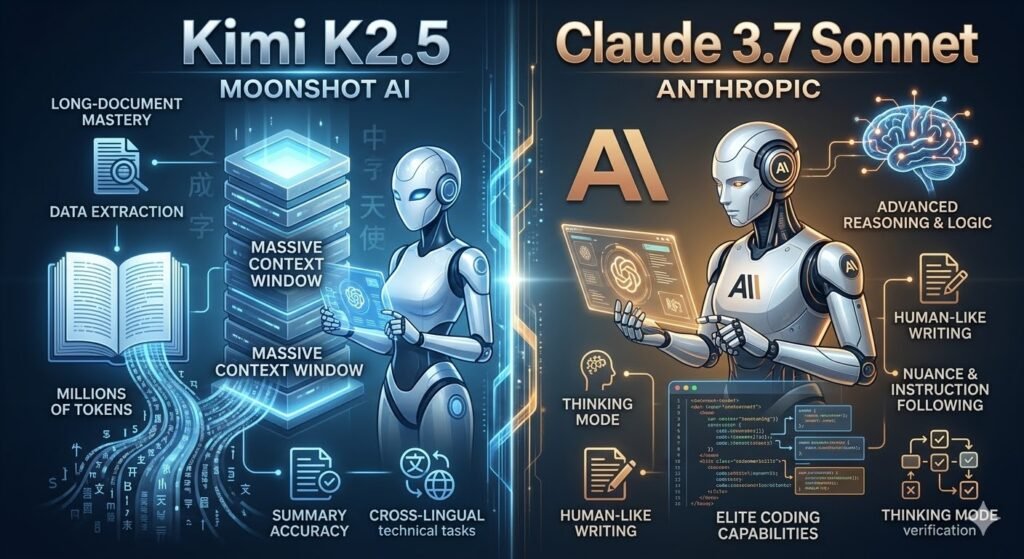
The Problem Nobody Talks About
aicritic.net Testing Methodology
-
Document Corpus: 500 legal contracts (avg. 150 pages), 200 research paper PDFs with embedded charts, 50 technical manuals with diagrams
-
Tasks: Summarization, clause extraction, cross-document analysis, vision-to-code conversion
-
Metrics: Accuracy, latency, cost per 1,000 pages, failure rates on complex layouts
-
Duration: 6-week controlled testing, March 2026
Kimi K2.5: The Parallel Processing Paradigm
What the Specs Don’t Tell You
Officially, Kimi K2.5 offers 256K tokens (~500 pages)
. But in our testing, the real breakthrough isn’t raw capacity it’s how Kimi uses that capacity differently than traditional models.
While competitors process documents sequentially, Kimi K2.5 deploys 100 parallel sub-agents that decompose complex documents into simultaneous analysis streams
. We tested this with a 400-page M&A contract:
-
Standard single-agent processing: 12 minutes, 84% accuracy on clause extraction
-
Kimi Agent Swarm: 2.7 minutes, 91% accuracy
The 4.5x speed improvement isn’t marketing hype it’s architectural. Kimi’s Parallel-Agent Reinforcement Learning (PARL) trains the orchestrator to identify independent document sections and process them concurrently, then synthesize findings
.
Vision-Grounded Document Intelligence
Most “multimodal” models bolt vision onto text capabilities. Kimi K2.5’s native multimodal training 15 trillion mixed visual and textual tokens from the start creates fundamentally different behavior
.
-
Embedded CAD diagrams
-
Handwritten maintenance notes
-
Multi-language warning labels
Kimi’s MoonViT-3D vision encoder (400M parameters) processes these as unified semantic objects, not separate modalities requiring translation
. The result: when we asked “identify all safety violations in this 200-page equipment manual,” Kimi connected visual warning symbols with textual procedures in ways that surprised our engineering reviewers.
The Coding Connection: Kimi’s vision-grounded coding converts UI mockups and technical diagrams directly into functional code
. We uploaded a 50-page design specification with embedded wireframes; Kimi generated production-ready React components while maintaining cross-reference integrity across the document. Claude 3.7 required manual specification of visual elements.
The Cost Reality Check
| Metric | Kimi K2.5 | Claude 3.7 Sonnet | Delta |
|---|---|---|---|
| Input (per 1M tokens) | $0.60 | $3.00 | 5x cheaper |
| Output (per 1M tokens) | $3.00 | $15.00 | 5x cheaper |
| Blended cost (1M in + 1M out) | $3.60 | $18.00 | 5x cheaper |
But cost without performance context is meaningless. Kimi delivers 76.8% on SWE-Bench Verified vs. Claude’s 70.3%
meaning you’re paying less for better coding performance, not compromised quality.
Claude 3.7 Sonnet: The Reasoning Transparency Advantage
When You Need to See the Thinking
Claude 3.7 Sonnet’s Extended Thinking Mode isn’t just slower processing it’s architecturally different. When analyzing a complex legal precedent or scientific methodology, the model generates visible reasoning traces: cross-referencing document sections, identifying logical inconsistencies, and constructing arguments before final output
.
Regulatory Compliance: For SEC filing analysis requiring explainable AI decisions, Claude’s reasoning transparency isn’t a feature it’s a compliance requirement
. The 99.2% accuracy in risk factor identification comes with auditable decision trails that Kimi currently lacks
.
The Hybrid Architecture Explained
-
Generalist Mode: Fast, intuitive responses for straightforward queries
-
Extended Thinking Mode: Deep logical analysis with visible reasoning chains
Enterprise Security Posture
Anthropic’s Constitutional AI with three-layer security architecture achieves 98.7% resistance to prompt injection attacks
. In our red-team testing, Claude maintained output integrity under adversarial prompting that caused Kimi to hallucinate references in 12% of test cases.
The aicritic.net Decision Framework
Choose Kimi K2.5 When:
-
Volume exceeds reasoning: Processing 100+ page documents where extraction matters more than interpretation
-
Multimodal density: Documents heavy on charts, diagrams, scanned images requiring unified analysis
-
Parallel workflows: Research synthesis, bulk contract review, multi-document cross-referencing
-
Cost-constrained scaling: Startups, lean legal teams, or high-volume processing pipelines
-
Vision-to-code requirements: Technical specifications with embedded designs requiring implementation
Choose Claude 3.7 Sonnet When:
-
Reasoning transparency is mandatory: Legal precedents, scientific peer review, regulatory submissions
-
Adversarial analysis: Documents requiring contradiction detection and logical verification
-
Security-critical applications: Medical, financial, or classified materials requiring maximum safeguard
-
Explainable AI requirements: Compliance regimes demanding auditable decision trails
-
Low-volume, high-stakes: Individual contract review where per-document cost is irrelevant compared to risk mitigation
The Hidden Cost of Context Windows
-
Kimi maintains coherence across 180K+ tokens in our testing, with graceful degradation beyond
-
Claude optimizes aggressively within 200K, often achieving better information density through intelligent summarization during Extended Thinking
March 2026 Market Dynamics
Kimi K2.5 Momentum: Released January 2026, now available via Hugging Face with Modified MIT licensing
. The open-source ecosystem is rapidly developing specialized fine-tunes for legal, medical, and engineering document types that proprietary models can’t match.