Physical Address
304 North Cardinal St.
Dorchester Center, MA 02124
Physical Address
304 North Cardinal St.
Dorchester Center, MA 02124
The landscape of digital productivity has undergone a seismic shift. In 2026, we are no longer talking about simple “if-this-then-that” rules. We have entered the era of Autonomous Workflows. For businesses and creators, the ability to build these workflows isn’t just a luxury it is the baseline for survival.
At AiCritic, we spent months analyzing how modern enterprises are integrating AI. The results are clear: those who automate their logic, not just their tasks, are scaling 10x faster.
Traditional automation was rigid. If you received an email, a tool like Zapier would simply move it to a folder. In 2026, an AI Automation Workflow uses a Large Language Model (LLM) as a “Decision Maker” in the middle of the process.
The AI now reads the email, understands the sentiment, checks your calendar, drafts a personalized reply, and only asks for your approval if the matter is high-priority. This is what we call “Cognitive Automation.”
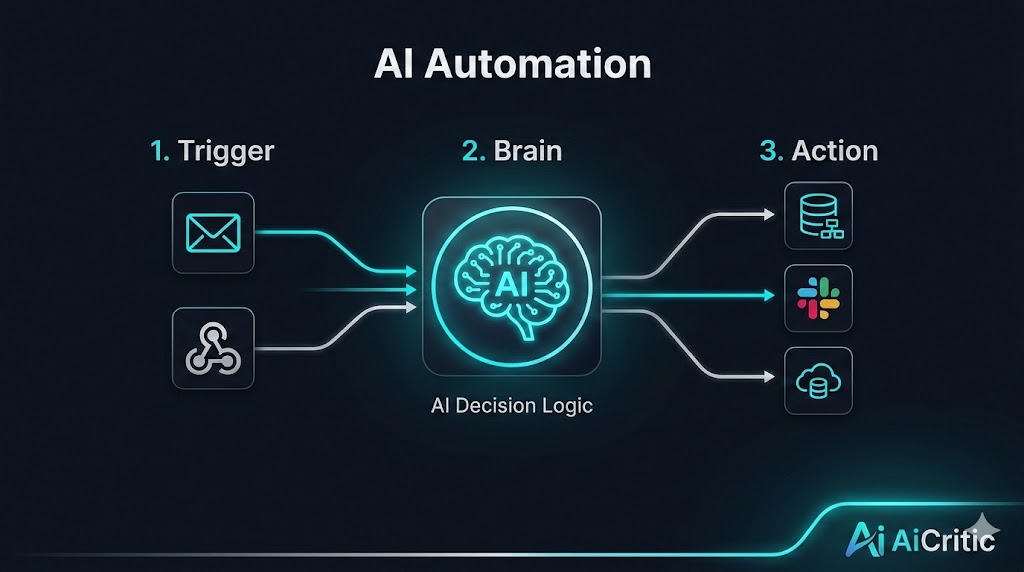
To build a premium workflow that Google recognizes as high-quality, you must understand the three-pillar architecture:
This is where the process starts. It could be a new lead in your CRM or a mention on social media. In 2026, triggers have become “multi-modal,” meaning an AI can trigger a workflow based on a voice command.
This is where tools like ChatGPT-5 or Claude 4 sit. Instead of just passing data, the “Brain” analyzes it. As we discussed in our recent analysis of AI Agents vs Chatbots: Why Traditional Bots are Fading, the brain’s job is to apply logic to raw data.
The result of the brain’s decision. This could be generating a report or updating a database like Airtable.
To build a site that looks like a “Premium Authority,” you must mention the industry leaders. Here is a comparison of the current ecosystem:
| Tool Category | Recommended Software | Best For |
| Orchestration | Make.com | Complex Visual Workflows |
| Logic Layer | OpenAI API | High-level reasoning |
| Data Storage | Pinecone / Airtable | Vector memory |
If you want to move beyond generic content, follow this technical blueprint:
Ingestion: Use a webhook to capture data from your website.
Filtering: Pass data through an AI agent to “Summarize” and “Categorize.”
Branching: If high value, send a Slack alert. If general, add to a digest.
Feedback Loop: Use the AI to check its own work. This is Self-Correcting Automation.
The biggest mistake is “Over-Automating.” When you remove the human element entirely, you risk losing the brand voice. At AiCritic, we recommend the 80/20 Rule: Let AI handle 80% of the repetitive work, but keep a “Human-in-the-loop” for the final 20% of creative decisions.
Building AI Automation Workflows is the single most important skill of this decade. By mastering the tools we’ve discussed, like those mentioned in our Top 5 AI SaaS Tools for 2026 guide, you are not just saving time you are building a digital workforce.





[…] we mentioned in our guide on AI Automation Workflows, integrating these tools into a single pipeline is the only way to scale your […]